Farmers Buy Just 1.2% of Land on the Market
L LandData Explorer August 24, 2026
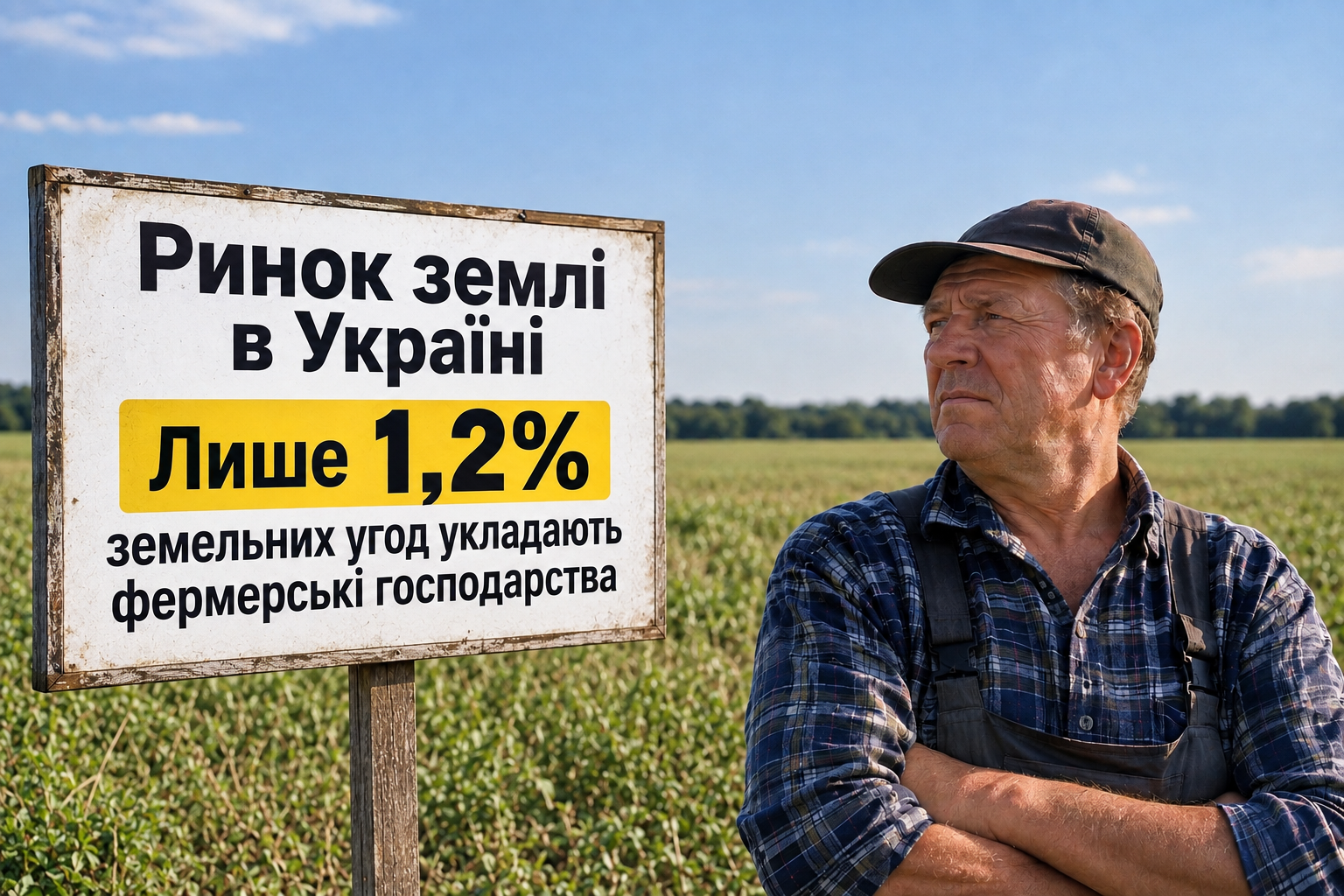
Since Ukraine’s land market began operating, farming enterprises have registered just 1.2% of all purchase-sale deals. The reason isn’t a lack of some particular support instrument — it’s the law itself: the act that opened the market on July 1, 2021 doesn’t define a purpose for doing so at all. That purpose only appears in the explanatory note to the bill, and it’s purely procedural — to guarantee citizens’ and legal entities’ right to freely buy and sell land. By comparison, in Denmark, Germany, Poland, Romania, Hungary, Czechia, and France, the law establishing their land markets explicitly names supporting and developing family farms as the main goal.
Let’s look at how the 457,700 agricultural land purchase-sale deals actually break down by designated purpose:
- Farming enterprise (5,363 · 1.2%)
- Commercial production (240,014 · 52.4%)
- Personal farming (180,896 · 39.5%)
- Other (31,460 · 6.9%)
Data covers all agricultural land purchase-sale deals over the entire observed period. Source: State Geocadastre land relations monitoring.
The picture looks similar by area: farming enterprises account for just 7.2% of the total area sold — so this isn’t a fluke in one particular metric, but a persistent structural feature of the market.
The cause is structural, not incidental: the relevant law simply doesn’t build in a goal of supporting farming — unlike every EU country listed above, where that goal is written into law and backed by concrete tools. Those countries run state land agencies that manage state-owned land for farmers’ benefit, along with a right-of-first-refusal mechanism that typically favors a tenant-farmer or the owner of a neighboring plot. Ukraine has neither an agency nor that kind of priority: the first right of refusal on a plot actually belongs to a holder of a special permit for extracting minerals of national significance, and only second to the tenant. Banks still offer next to no loans for buying agricultural land. All of this directly follows from the fact that developing farming simply wasn’t the goal when the market was opened.
Another telling fact is how much buyers from different categories actually pay per hectare:
Commercial production
UAH 50,286
Personal farming
UAH 61,992
Farming enterprise
UAH 33,686
Weighted average price per hectare over the entire observed period. Source: State Geocadastre land relations monitoring.
Interestingly, farming enterprises pay the least per hectare of the three categories — even less than personal (subsistence) farms. Pinning down the exact mechanism behind that gap would need dedicated research, but the direction fits the rest of the picture: without state support, accessible credit, or any real priority in the refusal queue, farmers remain the weakest participant in the land market — and that shows up not just in how many deals they make, but in what land and at what price they can actually afford.
For owners leasing land to farming enterprises, or considering selling to them, these numbers aren’t a reason to turn farmers away — they’re context: demand from farmers on the purchase-sale market is still very small, not for lack of interest, but because of a structural absence of the tools large agribusinesses have long relied on.